
Treehouses are one of the most iconic, versatile, and rewarding builds you can undertake in Minecraft. Whether you are attempting to stay safe from hostile mobs during your first few nights in Survival Mode or crafting a breathtaking, whimsical sanctuary in Creative Mode, building elevated structures within the canopy of a forest brings a unique blend of adventure, aesthetic appeal, and functional safety.
A well-crafted treehouse elevates your base above the dangers of Creepers, Zombies, and Skeletons while giving you panoramic views of your surrounding world. From rustic starter shelters hidden within natural jungle trees to massive, multi-tiered fantasy strongholds suspended high above the forest floor, the possibilities are virtually endless.
Below is a detailed guide featuring 20 unique Minecraft treehouse concepts, complete with design breakdowns, step-by-step building logic, and essential tips to help you construct the ultimate arboreal escape.
1. The Classic Survival Canopy Hut
What This Idea Means
The Classic Survival Canopy Hut is the quintessential early-game shelter. Built directly into the leaves of a tall tree—typically an Oak or Birch—this build focuses on safety, minimal resource consumption, and rapid construction. It blends seamlessly with the surrounding environment, keeping you safe from night-time threats without requiring massive amounts of stone or complex materials.
How to Make It
- Location Scouting: Find a dense forest and choose a sturdy, naturally tall Oak or Birch tree with dense leaf coverage.
- Ascension: Construct a ladder straight up the trunk to create a hidden vertical access point.
- Platform Building: Clear out a small space within the leaves and place a simple wooden plank floor ($5 \times 5$ or $6 \times 6$ blocks).
- Walls & Structure: Replace some of the surrounding leaves with glass blocks or wooden fences to serve as windows while retaining natural leaves for the outer walls.
- Roofing: Use a simple slab roof or retain the existing natural leaf ceiling for complete camouflage.
Tips and Variations
- Materials Needed: Oak/Birch logs, wooden planks, ladders, glass panes or wooden fences, torches, bed, and crafting table.
- Safety First: Light up the platform and surrounding branches thoroughly with torches to prevent mobs from spawning directly inside your leaves.
- Variation: Convert this into a double-tree layout by bridging across to an adjacent tree using wooden slabs and fences.
2. The Sprawling Jungle Canopy Mega-Base
What This Idea Means
Instead of building a single small room, the Jungle Canopy Mega-Base spans across multiple massive Jungle trees, creating a sprawling, high-altitude network. It relies on interconnecting rope bridges, skywalks, and functional multi-level platforms, serving as a complete late-game base high above the jungle floor.
How to Make It
- Core Foundation: Locate three or four massive $2 \times 2$ Jungle trees positioned close to one another.
- Connective Bridges: Build suspension bridges using Jungle slabs, trapdoors, and chains to connect the primary trunks.
- Zoned Platforms: Assign each tree a specific purpose—one for storage, one for enchanting, one for sleeping, and one for automated farming.
- Vertical Expansion: Add spiral staircases around the massive trunks to access different levels of each platform.
- Aesthetics: Wrap vines around the structures and hang lanterns beneath the platforms for a soft, atmospheric glow.
Tips and Variations
- Materials Needed: Jungle wood logs, Jungle planks, chains, wooden trapdoors, lanterns, vines, and scaffolding.
- Mob Safety: Secure the ground level around the trunks with fences or water barriers to prevent Creeper explosions from damaging the trunk bases.
- Variation: Add a water drop landing pad at the center for quick descent down to ground level.
3. The Cozy Cherry Blossom Loft
What This Idea Means
Introduced in recent updates, the Cherry Blossom biome provides vibrant pink foliage and soft particle effects that make for a dreamy, aesthetic treehouse. The Cozy Cherry Blossom Loft focuses on elegance, light colors, and romantic design elements perfect for Creative showcases or aesthetic Survival worlds.
How to Make It
- Site Selection: Find a elevated spot within a Cherry Grove biome featuring bright pink canopies.
- Base Frame: Build a charming, compact frame using stripped Cherry logs and pale Birch planks.
- Canopy Integration: Weave the build into the cherry leaves so the pink canopy overhangs the roof and balcony.
- Decking: Construct a wrap-around balcony with Cherry fences, flower boxes, and pink carpet accents.
- Interior: Decorate with pink beds, candles, books, and decorated pots filled with cherry saplings.
Tips and Variations
- Materials Needed: Cherry logs, stripped Cherry wood, Birch planks, Cherry fences, lanterns, candles, and flower pots.
- Color Contrast: Combine Cherry wood with Birch or Dark Oak to give the structural pillars definition against the pink leaves.
- Variation: Add a flowing waterfall beneath the treehouse that drains into a decorative koi pond on the ground.
4. The Ancient Dark Oak Fortress
What This Idea Means
The Ancient Dark Oak Fortress is a grand, brooding structure built within the thick, shadowy biome of a Dark Forest. Utilizing the dense $2 \times 2$ trunks of Dark Oak, this build feels like an impenetrable wooden castle suspended above a mysterious, dark woods.
How to Make It
- Multi-Trunk Base: Clear a central area between four large Dark Oak trees to serve as the corner pillars of your build.
- Floor Construction: Connect the four trees with heavy Dark Oak planks and Deepslate tile borders.
- Fortified Walls: Construct sturdy walls using a mix of Dark Oak wood, Cobblestone, and Slate, featuring narrow arrow slits made with stairs.
- Roof Design: Build a steep, pointed roof using Deepslate tiles or Dark Oak stairs to give it a gothic appearance.
- Defensive Balconies: Add overhanging watchtowers on each corner with drop chutes for dropping lava or water on hostile mobs below.
Tips and Variations
- Materials Needed: Dark Oak logs, Dark Oak planks, Deepslate tiles, iron bars, lanterns, and soul lanterns.
- Lighting: Use Soul Lanterns instead of standard torches to maintain a dark, moody aesthetic without sacrificing mob-proofing.
- Variation: Build a underground dungeon beneath the main tree roots for extra storage or brewing stations.
5. The Underground Root Haven
What This Idea Means
A unique twist on the traditional treehouse, the Underground Root Haven is constructed inside and underneath a giant custom tree. The visible structure on top appears modest, but a expansive nether-style or fantasy root system hides a cozy subterranean subterranean complex built into the roots.
How to Make It
- Custom Tree Base: Construct a thick, customized tree trunk using Brown Mushroom blocks, Mangrove logs, or Oak wood.
- Root Excavation: Hollow out the area beneath the tree trunk, leaving exposed “roots” made of wood logs twisting through the walls and ceilings.
- Living Space: Carve out rooms between the root structures, lining the floors with Moss blocks and Smooth Quartz for contrast.
- Natural Skylights: Dig vertical shafts up through the trunk, replacing sections with tinted glass to let natural sunlight stream into the underground rooms.
- Decorations: Hang glow berries, moss carpets, and spore blossoms throughout the cavern walls.
Tips and Variations
- Materials Needed: Oak/Mangrove logs, Moss blocks, Glow Berries, Hanging Roots, Tinted Glass, and Lanterns.
- Depth Control: Keep the build relatively high underground so you can naturally incorporate soil and greenery into the interior walls.
- Variation: Combine this with an overgrown library aesthetic using bookshelves nestled between giant wood roots.


6. The Suspended Fantasy Pod
What This Idea Means
Inspired by futuristic and fantasy architecture, the Suspended Fantasy Pod does not sit on top of branches. Instead, it hangs directly below a massive tree branch like a glowing fruit or seed pod. This build offers maximum vertical safety and a striking silhouette.
How to Make It
- Anchor Point: Locate or build a large, sweeping branch on a high tree canopy.
- Support Chains: Attach Chains or Iron Bars vertically downwards from the branch to establish support lines.
- Pod Frame: Build a spherical or teardrop-shaped pod frame using Glass, Smooth Quartz, or Spruce planks attached to the chains.
- Interior Space: Maximize internal volume by placing utility blocks (furnaces, chests, crafting tables) flush into the curving walls.
- Entryway: Access the pod via a central ladder system lowering down from the main branch above or a trapdoor at the bottom.
Tips and Variations
- Materials Needed: Chains, Glass blocks, Spruce planks, Sea Lanterns, Trapdoors, and Ladders.
- Shape Dynamics: Practice creating round spheres or teardrop forms using spherical building grids for an organic feel.
- Variation: Create a cluster of three hanging pods of different sizes, connected to each other by narrow chain pathways.
7. The Mangrove Swamp Stilt Village
What This Idea Means
Built inside murky Mangrove swamps, this layout uses sprawling aerial roots and elevated platform stilts to keep the base high above water level. It features a waterlogged, rustic aesthetic that blends seamlessly with swamp biomes.
How to Make It
- Location: Find a dense Mangrove biome with tall root clusters growing over shallow water.
- Stilt Framework: Extend the natural Mangrove root systems downwards using Stripped Mangrove Wood to form sturdy pilings.
- Elevated Boardwalks: Build open-air wooden pathways elevated two to three blocks above the water surface.
- Hut Construction: Build small, rustic huts with thatched roofs made of Hay Bales or Mud Bricks resting atop the platforms.
- Docks & Boathouses: Add lower platforms right at water level with boat docks for easy navigation through the swamp channels.
Tips and Variations
- Materials Needed: Mangrove wood, Mud Bricks, Hay Bales, Moss Carpets, Vines, and Torches.
- Atmosphere: Keep the greenery dense by planting Propagules along the boardwalk edges to grow extra roots over time.
- Variation: Add a dedicated fishing station with hanging fish nets (using cobwebs) over the swamp water.
8. The Spiral Spruce Watchtower
What This Idea Means
Designed specifically for Taiga and Mega Taiga biomes, the Spiral Spruce Watchtower utilizes tall, straight Spruce trees. A continuous wooden staircase wraps around the trunk from the ground all the way up to an elevated observation tower at the top.
How to Make It
- Tree Selection: Choose a naturally tall Spruce tree or grow a massive $2 \times 2$ Spruce tree using four saplings.
- Spiral Staircase: Wrap Spruce slabs and stairs around the central trunk in a continuous upward spiral pattern.
- Intermediate Platforms: Add small resting landings every 10 to 12 blocks for chests, mini-farms, or archery posts.
- Top Watchtower: Build a wide, octagonal lookout tower near the top canopy featuring open archways and a pointed roof.
- Lighting: Hang lanterns from the underside of the stairs to illuminate the path and the tree trunk continuously.
Tips and Variations
- Materials Needed: Spruce logs, Spruce stairs, Spruce slabs, Lanterns, and Fences.
- Archery Advantage: The top platform acts as an exceptional defensive tower for sniping hostile mobs at night.
- Variation: Cover parts of the roof with Snow Slabs to blend into cold, snowy taiga environments.
9. The Modern Glass Orb Treehouse
What This Idea Means
Merging sleek, modern architecture with natural landscapes, the Modern Glass Orb Treehouse suspended inside an artificial or natural tree canopy features clean geometric lines, white concrete, and full floor-to-ceiling glass walls.
How to Make It
- Custom Trunk: Build an elegant, curved trunk using Birch or Smooth Quartz pillars to give a clean contrast.
- Sphere Framework: Construct a glass sphere embedded directly inside the upper canopy using White Stained Glass and Quartz Slabs.
- Interior Minimalist Design: Keep interiors clean using light-colored carpets, sea lanterns embedded in floors, and minimalist furniture.
- Balcony Terraces: Extend flat, minimalist platforms out from the sphere edged with Glass Panes instead of traditional wooden fences.
- Access System: Use a hidden bubble elevator (Water + Soul Sand) encased in glass running through the center of the trunk.
Tips and Variations
- Materials Needed: White Stained Glass, Smooth Quartz, Sea Lanterns, Smooth Concrete, and Birch Wood.
- Lighting: Avoid traditional torches; use hidden light sources like Sea Lanterns beneath white carpets.
- Variation: Create a double-orb layout where one sphere serves as living space and the second as a fully glassed greenhouse.
10. The Enchanted Mushroom Tree Haven
What This Idea Means
Constructed within a Giant Red or Brown Mushroom—or built into a custom hybrid mushroom tree—this concept brings a fairytale, whimsical theme to life with vibrant colors, glowing vegetation, and soft, round shapes.
How to Make It
- Mushroom Base: Bone meal a Red Mushroom to create a giant stem and cap, or build a custom massive cap using Red Mushroom blocks.
- Multi-Floor Interior: Hollow out the cap of the giant mushroom into two internal floors.
- Glowing Accents: Embed Shroomlights or Froglights into the underside of the mushroom cap for soft illumination.
- Stem Living Space: Convert the hollow stem into a spiral ladder access point lined with bookshelves.
- Balcony Rim: Cut small archways out of the mushroom cap edge and extend small wooden balconies lined with flower boxes.
Tips and Variations
- Materials Needed: Red/Brown Mushroom Blocks, Shroomlights, Birch Planks, Vines, and Flowering Azalea.
- Silk Touch: Use a Silk Touch tool when harvesting mushroom blocks to repair or expand your structure without breaking them into mushrooms.
- Variation: Build this inside a Mushroom Island biome where hostile mobs naturally do not spawn.


11. The Nether Crimson Citadel
What This Idea Means
Brave the dangerous Nether dimension by building an outer-realm treehouse inside a Giant Crimson or Warped Fungus tree. This build provides an immune-to-fire sanctuary high above lava lakes and roaming Piglins.
How to Make It
- Fungus Growth: Grow a huge Crimson Fungus using Bone Meal on Crimson Nylium in the Nether.
- Fireproof Construction: Build the living area entirely out of Nether materials like Crimson Hyphae, Nether Bricks, and Blackstone.
- Lava Fall Defense: Drop controlled streams of lava from the upper canopy down around the sides to create an impenetrable defensive curtain.
- Enclosed Windows: Fully enclose all window spaces with Stained Glass or Nether Brick Fences to prevent Ghast fireballs from entering.
- Portal Core: Place a Nether Portal in the center of the structure to act as your transportation hub back to the Overworld.
Tips and Variations
- Materials Needed: Crimson/Warped Hyphae, Polished Blackstone, Nether Brick Slabs, Shroomlights, and Tinted Glass.
- Fire Safety: Crimson and Warped wood types are completely fireproof, making them ideal for high-risk Nether bases.
- Variation: Build a twin structure using Warped (cyan/blue) wood on the opposite side of a lava channel and connect them with a chain bridge.
12. The Pirate Ship Canopy Hideout
What This Idea Means
A creative mashup of nautical and arboreal themes, this build places a wooden pirate vessel trapped or deliberately constructed up in the thick branches of a dense forest canopy, acting as a secret bandit hideout.
How to Make It
- Ship Frame: Build a medium-sized wooden ship hull resting directly between two or three strong tree branches.
- Mast & Canopy Integration: Extend the ship’s masts upward so they poke through the top of the leaf canopy.
- Sails: Build dynamic, wind-blown sails using White Wool and Cobwebs attached to the yardarms.
- Captain’s Cabin: Turn the stern of the vessel into the main bedroom/base room with maps, armor stands, and gold chest displays.
- Anchor Drop: Hang heavy iron chains down from the bow of the ship down to ground level with an anchor resting on the forest floor.
Tips and Variations
- Materials Needed: Oak/Spruce Planks, White Wool, Chains, Stripped Wood, Barrels, and Lanterns.
- Details: Place barrels, trapdoors, and cannons (made with Black Concrete and stone button triggers) across the ship deck.
- Variation: Add a rope ladder trailing off the stern down to a concealed underground treasure vault.
13. The Minimalist Starter Tree Ring
What This Idea Means
A quick, highly accessible early-game design where a simple circular wooden platform is constructed around a single trunk mid-way up the tree. It is simple to assemble on day one or two of a new Survival world.
How to Make It
- Standard Tree Choice: Pick any standard single-trunk tree near your initial spawn area.
- Ring Platform: Build a flat ring of wooden slabs extending two blocks out from the trunk on all sides.
- Safety Fencing: Place wooden fences along the outer edge of the ring to prevent accidental falls.
- Essential Setup: Place your bed, crafting table, double chest, and furnace directly onto the ring floor.
- Ladder Access: Run a single column of ladders down the trunk to the ground, removing lower leaves for clarity.
Tips and Variations
- Materials Needed: Any basic wood planks, slabs, fences, ladders, and basic crafting stations.
- Quick Upgrades: Expand the ring outwards by one additional block whenever you need extra chest storage space.
- Variation: Add a second ring platform three blocks higher up the same tree trunk for an instant two-story starter base.
14. The Overgrown Elven Sanctum
What This Idea Means
Inspired by High Fantasy aesthetics, the Elven Sanctum combines organic curves, light woods like Birch and Oak, flowing water, and heavy lush greenery to create an ancient, magical tree dwelling.
How to Make It
- Sweeping Organic Branches: Construct massive custom tree limbs that curve gracefully outward and upwards.
- Light Wood Palettes: Construct delicate structures using Birch, Stripped Oak, Quartz, and White Wool.
- Flowing Water Features: Let natural water streams cascade down from upper leaf structures into lower pools.
- Organic Rooflines: Build swept-up rooflines using stairs and slabs that mimic opening leaf petals.
- Flora Details: Decorate extensively with Flowering Azalea, Moss Carpet, Vines, and Spore Blossoms for a constant particle effect.
Tips and Variations
- Materials Needed: Birch wood, Stripped Oak, Moss blocks, Azalea leaves, Glow Berries, and Quartz slabs.
- Particle Effects: Placing Spore Blossoms underneath floor platforms causes soft green particles to drift downwards, adding a magical feel.
- Variation: Build glowing crystal clusters using Colored Stained Glass with light sources inside them throughout the branches.
15. The Steampunk Windmill Tree Base
What This Idea Means
This concept combines industrial mechanics with natural builds by integrating a working or aesthetic industrial windmill and brass/copper machinery into the side of a colossal hollowed-out tree.
How to Make It
- Heavy Trunk Structure: Build a thick, sturdy tree trunk using Dark Oak and Spruce wood.
- Windmill Mechanism: Attach a large circular industrial hub to the side of the trunk using Copper blocks and Dark Oak logs.
- Blades: Build four large windmill blades extending outward using White Wool, Spruce Fences, and Trapdoors.
- Industrial Accents: Run Copper Pipes (using Lightning Rods and Copper Blocks) along the trunk down to ground level.
- Living Quarters: Build dynamic, boxy rooms protruding out from various heights of the trunk with stained glass windows.
Tips and Variations
- Materials Needed: Spruce Wood, Copper Blocks, Cut Copper Slabs, Lightning Rods, White Wool, and Spruce Fences.
- Weathering Effect: Allow the copper blocks to naturally oxidize over time to give the build an authentic aged industrial look.
- Variation: Add smoke stacks out the top canopy made of campfire smoke passing through chimneys.


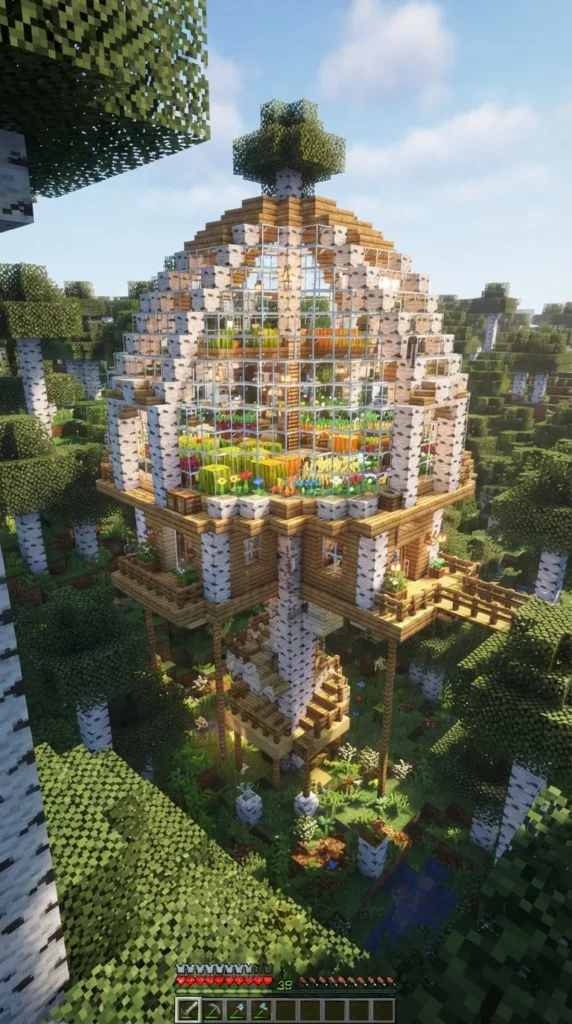
16. The Birch & Glass Greenhouse Canopy
What This Idea Means
Dedicated entirely to agriculture and botany, this build creates a light-filled elevated glass greenhouse built into the bright, yellow-green canopy of a tall Birch forest.
How to Make It
- Birch Stilt Support: Elevate a large wooden platform supported by tall Stripped Birch log pillars.
- Glass Dome Shell: Build a curved greenhouse dome over the platform using clear Glass and Glass Panes framed with Stripped Birch.
- Crop Layout: Lay out inner farmland rows irrigated by hidden water channels beneath the flooring.
- Beehive Integration: Hang Beehives and Bee Nests under the exterior branches with nearby flower beds to keep bees active.
- Vertical Growing Space: Use hanging ropes and chains with moss blocks to grow vertical hanging vines and berries inside.
Tips and Variations
- Materials Needed: Stripped Birch logs, Birch planks, Glass blocks, Glass Panes, Dirt, Farmland, and Beehives.
- Sunlight Optimization: Glass roofs ensure that crops grow rapidly without needing extensive torch setups inside.
- Variation: Dedicate half of the greenhouse structure to auto-smelting facilities powered by farm byproducts.
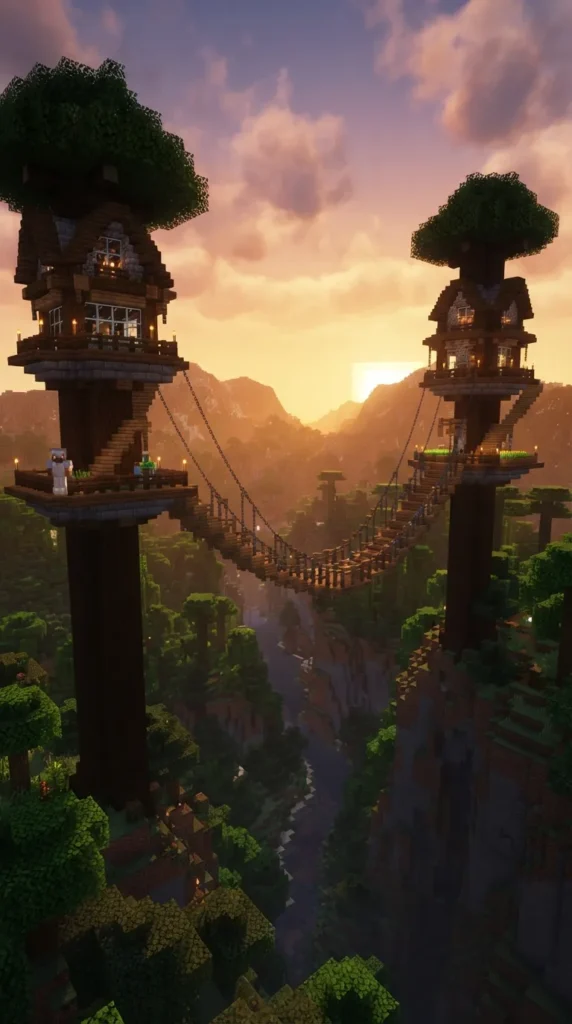
17. The Twin-Tree Hanging Bridge Fortress
What This Idea Means
This dual-structure concept builds two balanced, symmetrical wooden towers built on two separate adjacent tall trees, connected in the middle by a dramatic, dipping suspension bridge.
How to Make It
- Dual Tree Selection: Find two tall trees growing roughly 10 to 15 blocks apart from one another.
- Tower Structures: Construct matching multi-level wooden forts around both tree trunks.
- Suspension Bridge: Create a drooping bridge between them using Oak Slabs, Chains, and Wooden Trapdoors on the sides.
- Functional Division: Set up Tower A as your private living quarters and Tower B as a dedicated crafting, storage, and smithing area.
- Defensive Balconies: Build overhang platforms on the outer sides of both towers equipped with crossbow turrets and dispensers.
Tips and Variations
- Materials Needed: Oak logs, Spruce slabs, Chains, Oak trapdoors, Iron railings, and Lanterns.
- Bridge Realism: Make the bridge sag slightly in the middle (using lower slabs) to simulate realistic weight and gravity.
- Variation: Add a central hanging platform suspended underneath the exact middle of the suspension bridge.
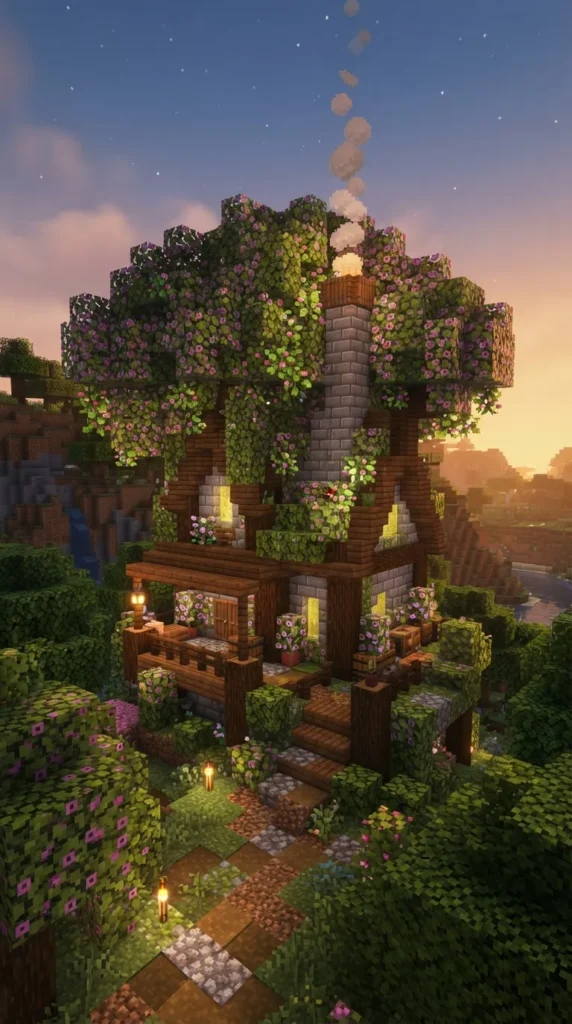
18. The Azalea Leaf Cottage
What This Idea Means
Utilizing the rich green and pink-flowered foliage of Azalea trees, this build creates a soft, fairytale-style thatched cottage buried inside a natural or custom Azalea tree canopy.
How to Make It
- Custom Azalea Canopy: Combine standard Azalea Leaves and Flowering Azalea Leaves into a large, dense sphere canopy.
- Embedded Cottage: Build a charming cottage directly inside the center, letting leaf walls poke through into interior rooms.
- Roofing: Build a steep, sloping roof using Spruce Stairs trimmed with Stone Brick Slabs for texture contrast.
- Porch & Garden: Add a small wraparound wooden porch with hanging flower baskets and potted azaleas.
- Chimney: Run a stone brick chimney from the cottage interior up through the leaf canopy with a campfire at the top for smoke.
Tips and Variations
- Materials Needed: Azalea leaves, Flowering Azalea leaves, Spruce wood, Stone bricks, Flower pots, and Campfires.
- Color Palette: The vibrant green of Azalea leaves pairs exceptionally well with dark Spruce wood and gray Stone Bricks.
- Variation: Add a small secret trapdoor in the cottage floor that drops down into an underground enchanting cellar.
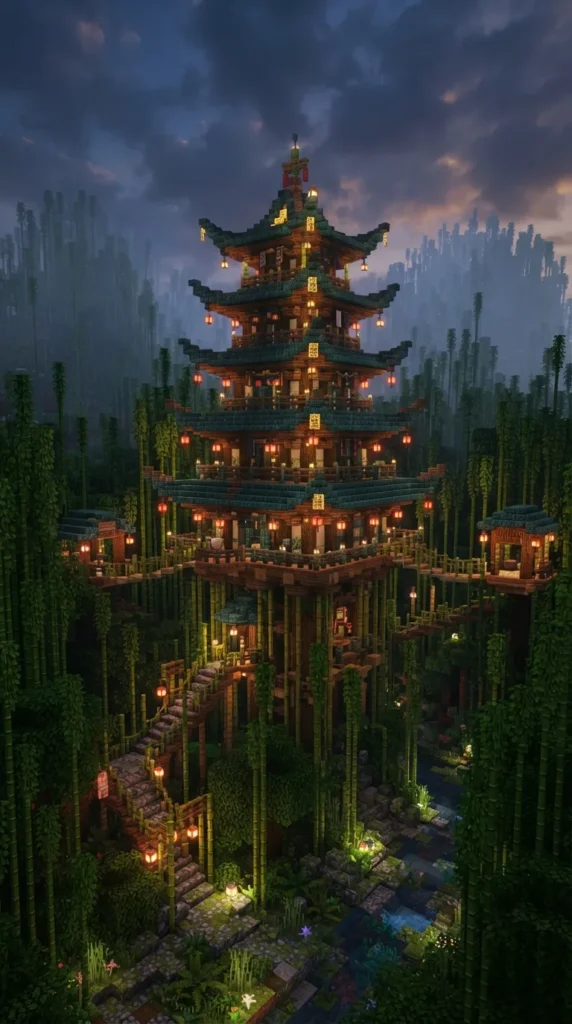
19. The Bamboo Forest Pagoda Treehouse
What This Idea Means
Set deep within a dense Bamboo Jungle, this oriental-inspired structure mimics a traditional multi-tiered Asian pagoda elevated high up on thick bamboo-style wooden stilts and jungle foliage.
How to Make It
- Elevated Foundation: Build a sturdy grid of elevated stilts using Stripped Bamboo Wood or Stripped Jungle Logs over a bamboo forest.
- Tiered Roofs: Build a three-tiered structure where each floor has a flared roofline made of Dark Prismarine or Nether Brick stairs curved up at the corners.
- Open Archways: Keep the walls open using Bamboo Fences and Paper Lanterns (Sea Lanterns surrounded by Trapdoors).
- Bamboo Paths: Create narrow, winding pathways at canopy level using Scaffolding and Bamboo Slabs.
- Zen Decor: Incorporate small water basins (cauldrons), flowering banners, and potted bamboo on every level.
Tips and Variations
- Materials Needed: Bamboo Wood, Bamboo Fences, Nether Brick/Prismarine Stairs, Scaffolding, and Lanterns.
- Curved Roof Trick: Use slabs and stairs placed at outward angles on the roof corners to achieve the traditional upturned pagoda roof look.
- Variation: Build a central hollow drop shaft inside the pagoda with a vertical slime-block launcher for quick vertical movement.
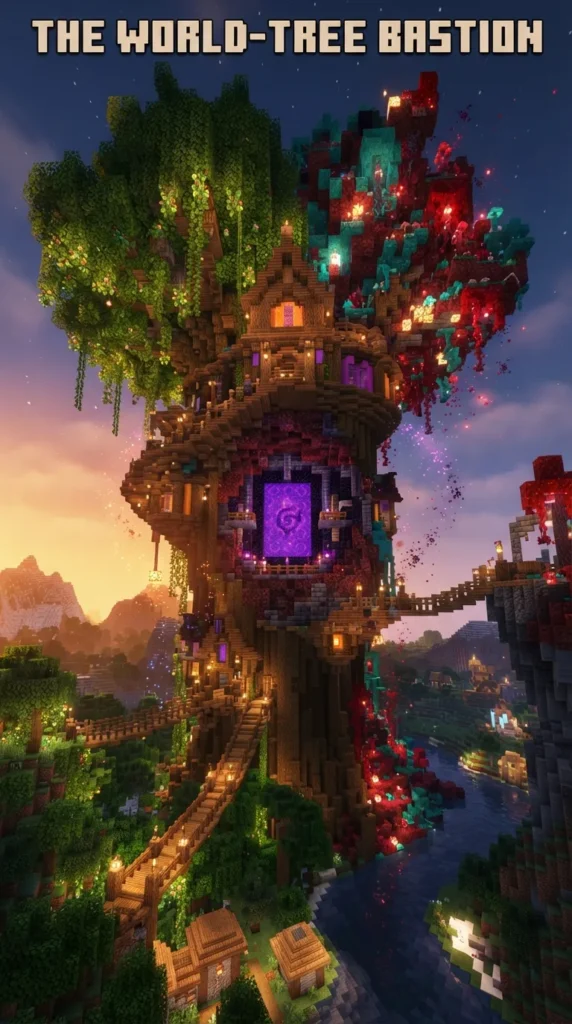
20. The Nether Portal World-Tree Core
What This Idea Means
The ultimate late-game base concept: A colossal, custom-built “World Tree” (Yggdrasil style) whose core trunk is literally made of a giant Nether Portal, splitting the build between Overworld greenery on one half and Nether flora on the other.
How to Make It
- Massive Custom Trunk: Construct a huge hollow trunk using a blend of Oak Logs, Dark Oak Logs, and Obsidian blocks.
- Integrated Portal: Build a massive custom-shaped Nether Portal frame inside the core of the trunk and light it.
- Split Aesthetics: Build the left side of the tree canopy using Oak leaves, vines, and lanterns. Build the right side using Nether Crimson fungi, weeping vines, and shroomlights.
- Root Networks: Extend massive roots outward in all directions, spreading over the surrounding landscape.
- Floating Islets: Build small floating island platforms around the tree branches connected by magic particle beams (colored stained glass panes).
Tips and Variations
- Materials Needed: Obsidian, Netherrack, Oak Logs, Crimson Hyphae, Oak Leaves, Nether Warp Leaves, and Shroomlights.
- Scale Matters: This build requires significant space and resources; plan out the trunk footprint ($15 \times 15$ minimum) before building upwards.
- Variation: Build functional rooms inside the massive hollow roots extending deep into the ground.
More ideas to come in future addition


